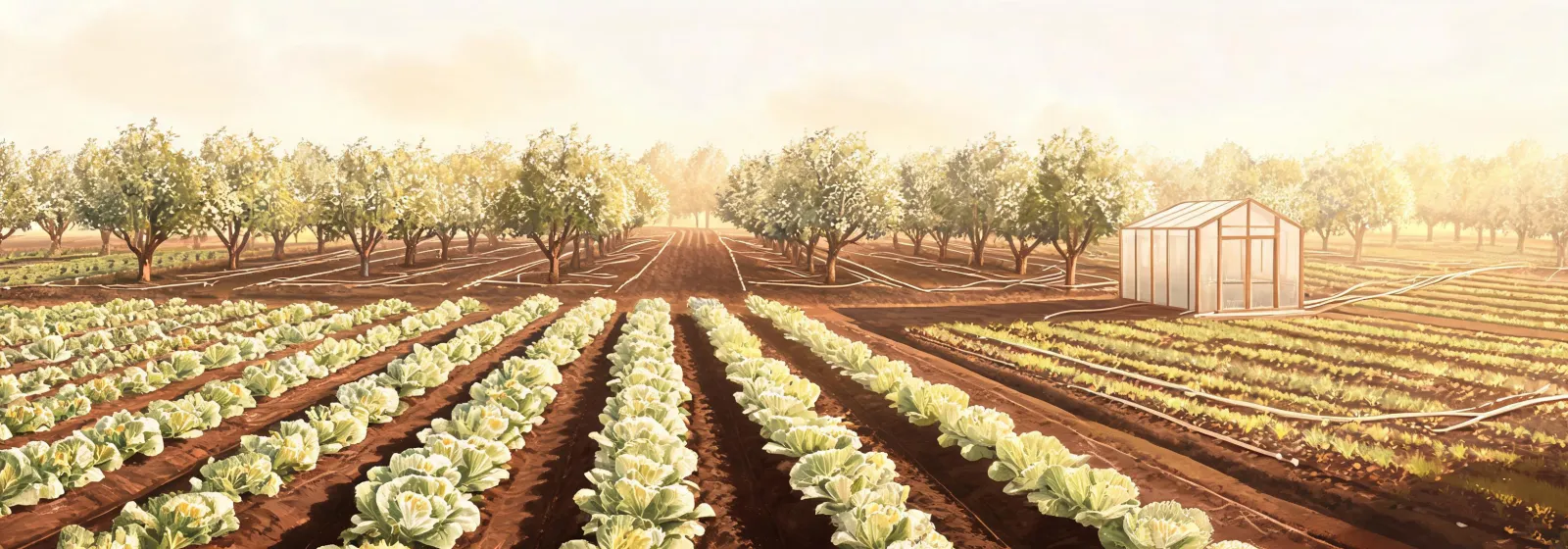
Vegetable beds
Frequent seasonal changes
Identify beds irrigated at once, emitter spacing and lateral lengths. Record the lowest and highest zone demand to ask whether a proposed regulator operates within its stated flow range. A pump rating alone does not describe pressure available at the zone inlet.
Include filter location, flushing arrangements and whether disposable tape or reusable hose is being considered. Keep replacement fittings and packing quantity separate in the RFQ.
Orchards and vineyards
Rows with changing elevation
Give block elevations, row lengths and the emitter arrangement. Ask the designer to evaluate pressure distribution and whether pressure-compensating emitters are appropriate; a regulator at one point does not remove every elevation or friction effect.
Specify connection orientation, isolation valves, access for maintenance and the conditions under which supplier flow and pressure data were obtained.
Greenhouse production
Multiple controlled zones
List controller interface, valve sequencing, fertigation arrangement and operating water temperature. Separate the regulator's hydraulic suitability from electrical or control compatibility. Ask for chemical-compatibility information for the actual fertilizer program.
Installation, commissioning, backflow protection and local compliance review need named responsibilities. They are not included simply because a component can be quoted.
Nursery blocks
A changing mix of containers
Record the active outlets for each zone, not just the total nursery area. Compare regulator performance data at the intended demand and request a maintenance route for sediment, blocked emitters or interrupted supply.
For mixed drip and micro-sprinkler areas, keep the operating requirements distinct. Ask whether separate pressure regulation is needed rather than assuming one setpoint suits both.